
Telling Your Heroine's Story Writing Contest: First Place Winner Ellen Webster
Jan 26, 2026We Are the Heroines of Our Own Stories
In December, we announced the winners of our 3rd Annual Heroine’s Writing Contest. We gathered at The Inn at Bath to celebrate and had our first-prize winner, Ellen Webster from Hoboken, N.J., on Zoom to witness the event. Can I just say, it’s so much fun to award these prizes?
Margaret, Kim, Kathy, and Phyllis were our four distinguished judges, again, who had a month to read the entries and score them. We couldn’t have done the contest without the four of them. Here’s a shout-out to these talented women – heroines in their own right. We've linked their names to their sites. Take some time to check them out. You'll be glad you did!
The entries were evaluated according to the contest criteria, and the judges’ scores for the nominees were remarkably similar, making it easy to decide on all the winners: First Place went to Ellen Webster, Second to Dory Cote, Third to WenLin Tan, and Honorable Mention to kdb. (We’ll feature each of our amazing prize winners in the following months.)
Meet Ellen Webster
We are proud to begin celebrating with our first-place winner, Ellen Webster, whose story of resilience and heart is enough to brighten anyone’s day. It’s a beautiful story, full of hope. Reading it will help you find your way through any dark time, I’m sure of it.
I first met Ellen in April when she wrote me an email:
“As I start the slow process of marketing and discovery, I know that promoting other women and their work is part of what is especially important to me. Please help me understand how I can help promote what you do. “
This is the essence of Ellen, I’ve discovered. Whether it comes from her practice of writing thank-you notes (she’s written 10,000 so far) or it’s just ingrained in her somehow, she is so appreciative of others and lets them know it. It’s genuine. She is reaching out to help you, to say she sees you, and I have to say, it feels very good to know there’s someone out there paying attention.
Since our first connection, Ellen has skyrocketed in national attention. She has officially gone viral. She has been on The Today Show; here’s what Today wrote about her.
As much as I can write about Ellen, we’re here about the story she entered into our contest, the first prize winner of $500. And get this, now that I’ve come to know Ellen, it’s not surprising… she turned right around and donated half of her prize money to weHeroines, now a non-profit 501c3!!
Want to learn more about Ellen? Visit her website and follow her on Instagram.
Now, without further delay, here’s Currents of Connection.
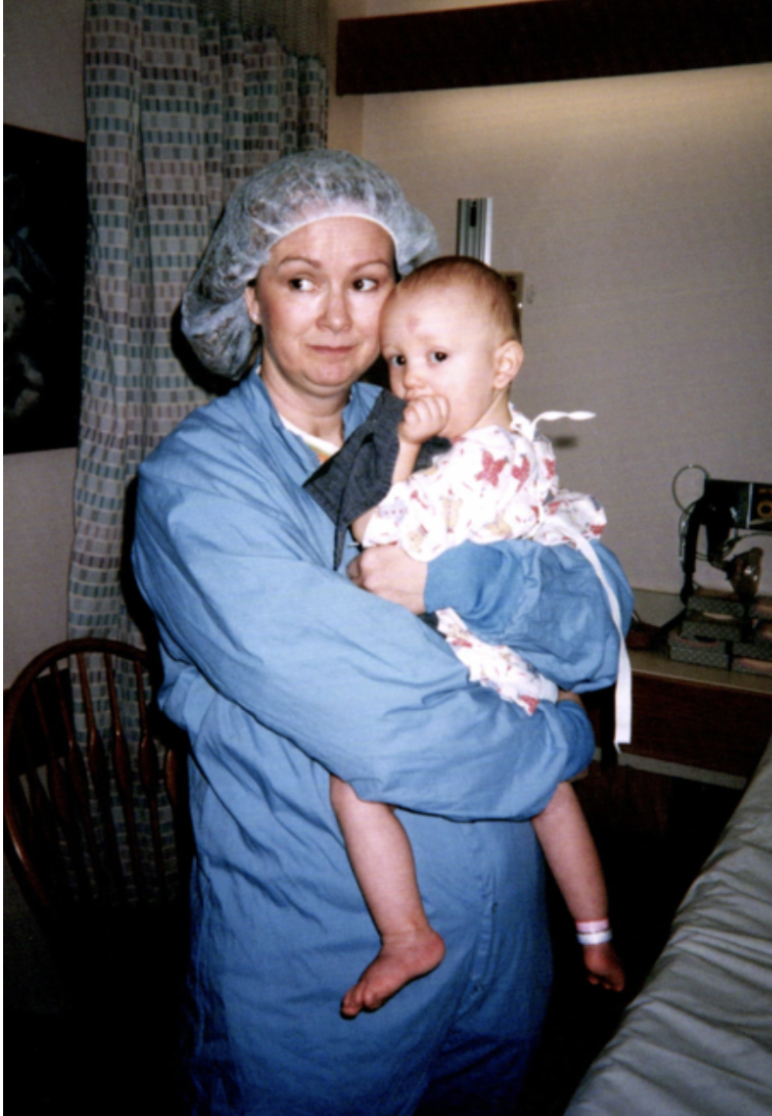
Ellen and Byron, October 1997
Currents of Connection
When Byron was four-and-a-half months old, they said he had Sturge-Weber Syndrome and would need the entire left half of his brain removed—from the frontal lobe to the cerebellum.
I said no until I said maybe, which held firm up to the day I called the doctor from a fast-food parking lot and choked out an ok.
Then, one early morning during the tenth month of his life, I stepped into a sky-blue coverall and stretched booties over my loafers. I stooped so a nurse could place a cap on my hair, receiving it like a crown at a pageant—a strange thought in that moment. And after a face mask was secured, I walked my baby through multiple sliding doors and into an operating room where I placed him on a gurney deep inside Children's Hospital Boston. As instructed, I laid his head in a semidome of Styrofoam positioned close to a shiny circular saw.
I sensed compassion from those in the room, but with trembling hands and tears about to break the levee of my eyelids, I couldn't risk connecting. The goodbye was hurried, and as I walked back to the waiting room, a nurse offered saltines. In case my tummy was upset, she said. I couldn't know then that this small gesture would change how I saw the world. I turned down the crackers but accepted a hug. Hers was the face of all I put my trust in that day.
* * *
When I was seven, my father and I walked down our street, fingers entwined. "Why do people hold hands?" I asked. "Because they lead directly to our hearts," he said.
Years later, in hospital hallways and waiting rooms, I felt that same current.
* * *
"I had not been born with an imagination large enough to encompass this moment," says one of Ann Patchett's characters in The Dutch House. But it turns out the boundaries we place on our imaginations are malleable. Given permission, they crumble so something new can be built.
Near-strangers gave me that permission, showing me what I couldn't yet see. Edith was first. A Jamaican hospital janitor, she rested her hands on my shoulders and said, "He's going to be better than ok." A butterfly clip bounced in her silver hair.
Donna, our first physical therapist in rehab, greeted my older daughter Audrey, Byron, and me: "Two perfect children!" No one had said that before. Damage and loss are easier to see.
Then Dr. Duffy, the neurologist I clung to like a life ring, said, "He has every chance at a normal life."
Fellow parents embraced me as a comrade in an unwanted war. Others simply showed up—listening without trying to fix anything. Accepting care in all its shades became the fulcrum. Clarity arrived through the cracks: the picture I had of my life—what it was supposed to deliver to me—had to go.
More than a year later, I attended a spiritual workshop that urged me to do just that. We were asked to write down one thing we no longer needed. Discouraged and bone-tired, I scribbled an enormous pledge, crumpled the paper, and tossed it into a burning bowl: "I release all preconceived ideas about my life and future." The changes came swiftly.
* * *
The surgery worked. Byron learned to walk, talk, and connect emotionally in extraordinary ways. He graduated college and now works in sports marketing—his dream industry. In his keynote, Half Brain. Full Life, he tells audiences: "You are not broken. You are not late. You are not too much. You are exactly what's needed to live a life that's yours."
Audrey knows medical care from both sides. Years spent accompanying her brother to therapy sessions while he learned to navigate the world in new ways gave her something she carries into her work as an anesthesiologist: understanding what it means to be the family member waiting, watching, hoping.
And within a week of releasing my grip on how life should be, the man who would become my husband stepped forward—drawn to all of us from a place of reality and acceptance, seeing life as it actually was.
* * *
It started with saltines. Now I see the small acts everywhere—the ones that keep us afloat and connect us to something beyond words. Love, maybe. Offered simply. When it matters most.
Don't miss a beat!
New moves, motivation, and classes delivered to your inbox.
We hate SPAM. We will never sell your information, for any reason.

